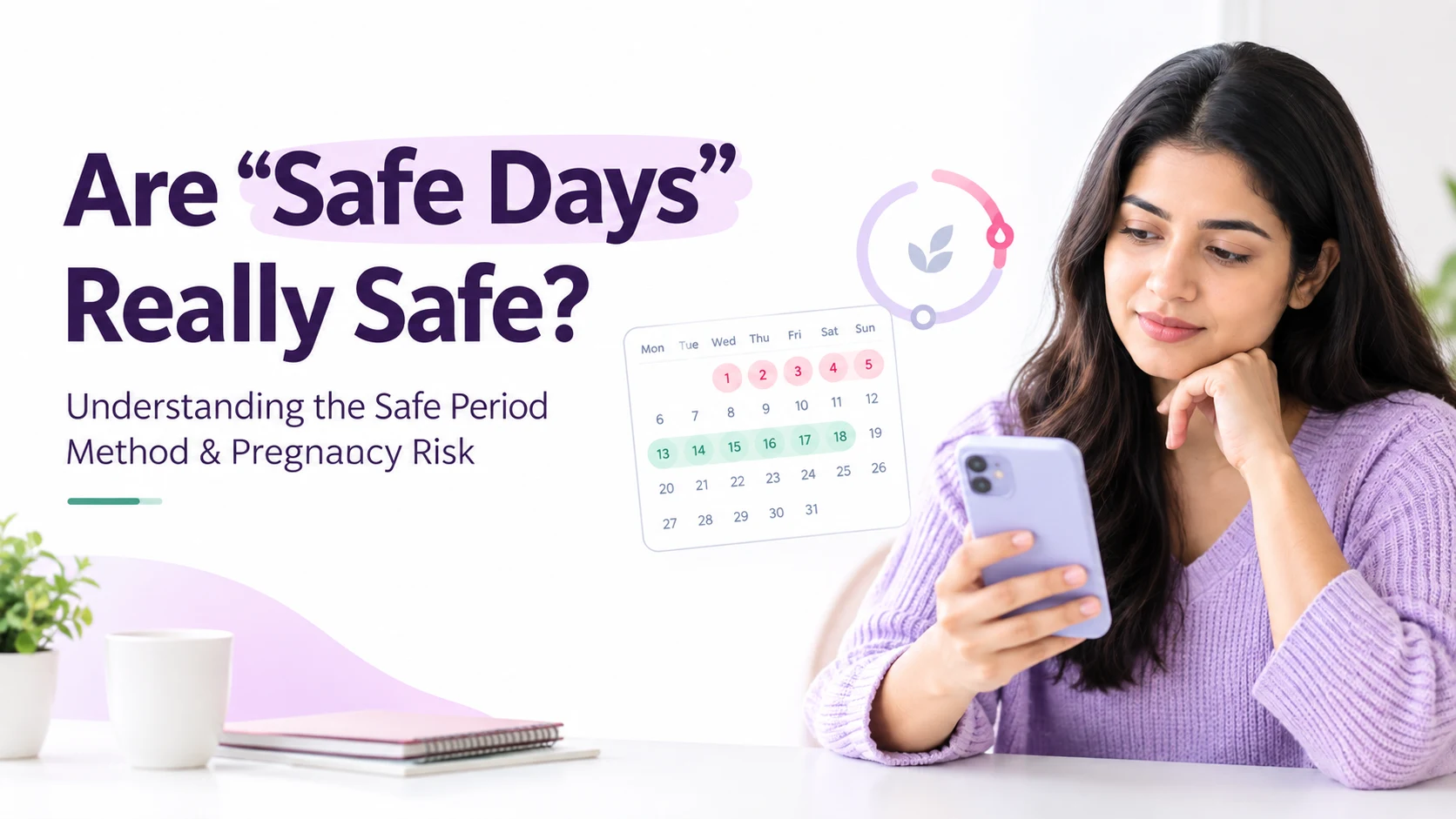
What is the "safe period" or rhythm method, exactly?
It's the practice of avoiding unprotected sex during your estimated fertile window. During the days when ovulation is not likely, couples have unprotected intercourse. It's one form of what's more broadly called "fertility awareness" or "natural family planning."
How do you find your unsafe days?
Every month, your body releases one egg. If the egg meets a sperm, a baby can start to form. The "safe period" method tries to find the days when this can happen, so you can avoid sex on those days.
But we cannot see the exact day the egg comes out. Sperm can also survive inside your body for up to 5 days, and the egg lives for only about 1 day. So the unsafe days are not one day — they are a group of days. This method helps you find that group with a simple calculation.
How is the "safe period" usually calculated?
The traditional calendar method works off your shortest and longest cycles over at least six months. The logic rests on sperm surviving up to five days inside the body and an egg being viable for roughly 24 hours after ovulation.
How effective is it, really?
With typical, real-world use, it's considered about 75% effective — a roughly 25% failure rate over a year of use as a sole method. That's dramatically less reliable than condoms, hormonal methods, or IUDs. The gap between how effective people assume it is and how effective it actually is, is exactly where unplanned pregnancies happen.
Why is it so much less reliable than other methods?
Because it depends entirely on a prediction, and ovulation is genuinely not that predictable. Stress, illness, travel, and normal month-to-month variation can all shift when you actually ovulate — sometimes earlier, sometimes later than your calculated window. The method assumes every cycle will be consistent, but that's not the case for many women, who have irregular, unpredictable cycles.
Can a period tracker app calculate my "safe days" for me?
A period tracker lets you know about ovulation, so it's tempting to assume that if it can tell you your fertile period, the remaining days must be a safe period. An ovulation tracker is good for estimating your fertile window, but it's not reliable for calculating a genuinely "safe" period. If an app's "safe days" feature is being used as your only method of avoiding pregnancy, it's worth understanding that clearly before relying on it.
Does having an irregular cycle make this method riskier?
Significantly, yes. The entire calculation depends on a consistent, trackable pattern. With an irregular cycle, predicting ovulation becomes far less accurate, which makes the "safe" window considerably less safe. If your cycles vary a lot month to month, this method carries meaningfully more risk for you.
Is the rhythm method the same as the "withdrawal method"?
No — they're often mentioned in the same breath but are different methods. The rhythm method is about timing (avoiding sex during the fertile window); withdrawal is about a physical act during sex (withdrawing before ejaculation) regardless of timing. Some people combine both, but each carries its own separate, and similarly imperfect, failure rate.
What are more reliable alternatives if I want to avoid pregnancy?
Condoms, oral contraceptive pills, IUDs (copper or hormonal), and implants all have meaningfully lower failure rates than the calendar method, with IUDs and implants being the most effective, "set and forget" options. The right choice depends on your health history, whether you're breastfeeding, your future family planning timeline, and personal preference — genuinely worth a direct conversation with your gynaecologist rather than choosing based on what a friend uses.
Does tracking still have a place if I know it's not fully reliable?
Yes — tracking your cycle is still genuinely useful for understanding your body, planning around your period, and noticing patterns worth flagging to a doctor. The issue isn't tracking itself, it's leaning on it alone as your only method to prevent pregnancy. Many people combine cycle tracking with a backup method during the fertile window specifically, which meaningfully improves overall effectiveness.