Pregnancy Scans in India: Which Ultrasound Scans Are Needed and When?
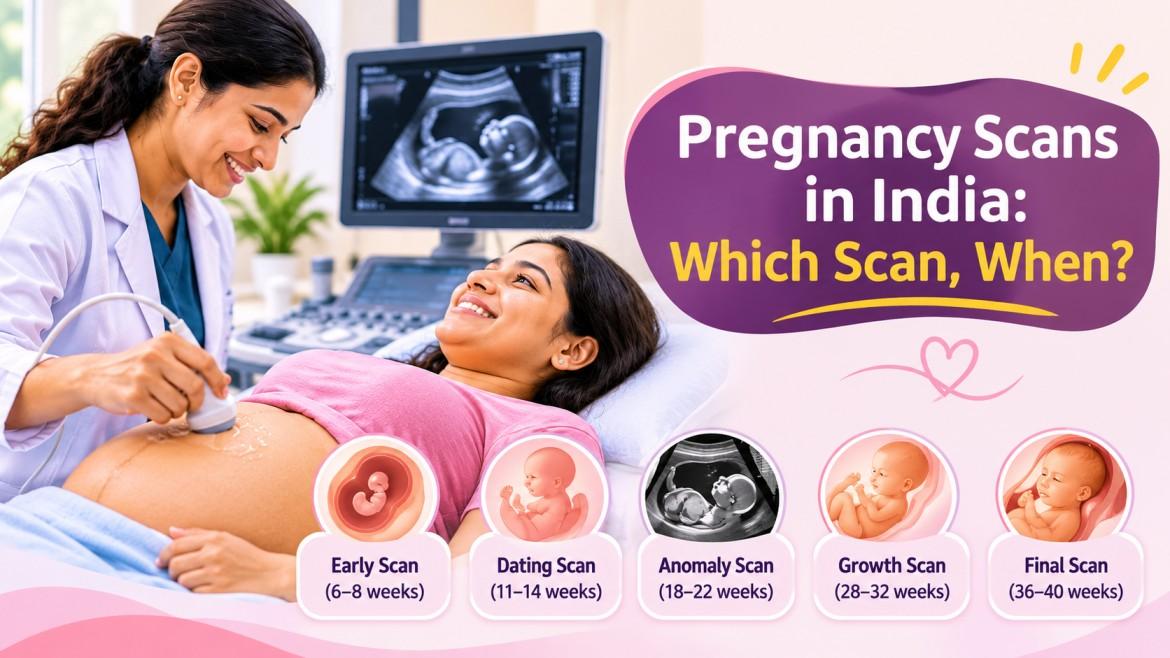
Your first pregnancy scan, the NT scan, the detailed anomaly scan… there seem to be so many scans to remember during pregnancy! And each time your doctor writes a new scan on your prescription, you may wonder what it is for and whether everything is okay.
The good thing is that every scan has a specific purpose. Some confirm your pregnancy and due date, some check your baby's development, while others help monitor growth and blood flow later in pregnancy.
Let's go through the important pregnancy scans, when they are usually done and what you can expect at each stage.
Download MiGynae – Your Pregnancy Care Companion
Track your pregnancy symptoms, log scan appointments, and get OBGYN-backed guidance tailored to Indian mothers.


Number of Ultrasound Scans During a Normal Pregnancy
There isn't one fixed number of ultrasound scans that every pregnant woman needs. It depends on your pregnancy, medical history and your doctor's assessment.
Your doctor may recommend:
- An early pregnancy or dating scan, if needed.
- An NT scan during the first trimester.
- A detailed anomaly scan in the second trimester.
- A growth scan in the third trimester, if advised.
- Additional scans or Doppler studies if there is a medical reason.
Some women may need more scans to monitor specific concerns, such as high blood pressure, diabetes, twins or slow fetal growth. This does not automatically mean something is wrong.
The aim is not to have as many scans as possible, but to have the right scans at the right time.
First Pregnancy Scan: Dating and Viability Scan
Usually around 6–10 weeks, when an early scan is needed
This is often the first ultrasound during pregnancy. It helps confirm that the pregnancy is inside the uterus and checks whether the baby is developing as expected for that stage.
Your doctor may use this scan to:
- Confirm the location of the pregnancy.
- Check for a heartbeat, depending on how early the scan is done.
- Estimate your pregnancy week and expected due date.
- Check whether you are carrying one baby or twins.
If your periods are irregular or you are unsure about your last menstrual period date, an early scan can be particularly helpful in estimating your due date.
Don't worry if the scan is done very early and everything cannot be seen clearly. Sometimes a repeat scan after a few days is needed.
NT Scan and First-Trimester Screening
11 weeks to 13 weeks and 6 days
The NT (nuchal translucency) scan is an important first-trimester screening scan. It measures a small fluid-filled space at the back of your baby's neck.
Along with your age and other screening information, this measurement helps estimate the chance of certain chromosomal conditions, including Down syndrome.
Your doctor may also recommend a blood test called the Double Marker test along with the NT scan.
A few things to remember:
- The NT scan is a screening test, not a diagnostic test.
- A higher-risk result does not confirm that your baby has a chromosomal condition.
- Your doctor may discuss further screening, such as NIPT, or diagnostic testing if needed.
Try not to miss this scan window, as the measurement is useful only during a specific stage of pregnancy.
Anomaly Scan (Level II or TIFFA): The Detailed Baby Scan
Usually between 18 and 22 weeks
This is one of the most important scans of pregnancy. Also called the Level II or TIFFA scan, it gives a detailed look at your baby's developing organs and body structures.
The doctor or sonologist examines:
- Brain and skull.
- Face and spine.
- Heart and chest.
- Stomach, kidneys and bladder.
- Arms, legs, hands and feet.
- Placenta and amniotic fluid.
- Cervix, when indicated.
The scan helps identify many major structural abnormalities and checks whether your baby's organs are developing as expected.
It may take longer than your earlier scans because several structures need to be examined carefully. Sometimes the baby is not in the right position, and you may be asked to walk around or return for a few additional images.
Remember, even a normal anomaly scan cannot detect every possible birth defect or health condition.
Fetal Echocardiography: A Closer Look at Your Baby's Heart
Usually around 18–24 weeks, when indicated
A fetal echo is a specialised ultrasound that examines your baby's heart in greater detail. It looks at the heart's structure, chambers, valves and blood flow.
It is not routinely needed in every pregnancy. Your doctor may recommend it if:
- A possible heart abnormality is seen during the anomaly scan.
- You have certain medical conditions, such as diabetes present before pregnancy.
- There is a close family history of congenital heart disease.
- Your baby has certain scan findings that need further assessment.
Being advised to get a fetal echo does not mean your baby definitely has a heart problem. It simply allows the specialist to examine the heart more closely.
Third-Trimester Growth Scan
Usually between 32 and 36 weeks, if advised
As your baby grows, your doctor may recommend a growth scan to check whether the baby is growing as expected.
This scan usually assesses:
- Estimated fetal weight and measurements.
- Baby's growth in relation to the pregnancy week.
- Amniotic fluid levels.
- Placental position.
- Baby's position in the uterus.
It is particularly useful when there are concerns about slow or excessive growth, high blood pressure, diabetes or other pregnancy-related conditions.
The timing may be different depending on your medical history and the reason for the scan.
Doppler Scan: Checking Blood Flow to Your Baby
A Doppler scan is used to assess blood flow through selected blood vessels, such as those in the umbilical cord and baby's circulation. It helps your doctor understand how well blood is flowing between the placenta and baby.
Your doctor may recommend it if:
- Your baby is measuring smaller than expected.
- There is a concern about fetal growth restriction (FGR).
- You have high blood pressure or pre-eclampsia.
- There is a concern about placental function.
Doppler is not required in every uncomplicated pregnancy. It is usually advised when your doctor needs additional information about your baby's circulation and wellbeing.
It may be performed along with a growth scan or as a separate examination.
Pregnancy Ultrasound Costs in India and Free Scan Options
The cost of pregnancy scans varies depending on the city, hospital, diagnostic centre and type of scan.
A detailed anomaly scan may cost a few thousand rupees at a private centre, while specialised scans such as fetal echo or Doppler may have separate charges.
Before booking, ask the centre about the total cost, whether the report is included and whether any additional assessment may be charged separately.
Free ultrasound services under PMSMA
The Government of India's Pradhan Mantri Surakshit Matritva Abhiyan (PMSMA) provides free antenatal care on the 9th of every month at designated government health facilities. Services include antenatal check-ups, investigations and ultrasound facilities.
You can contact your nearest government health centre to check availability and the process for getting a scan.
Ultrasound Safety During Pregnancy
One common worry among expectant mothers is whether repeated ultrasound scans can harm the baby.
Ultrasound uses sound waves, not X-rays or radiation. Diagnostic ultrasound has a well-established safety record when performed by trained professionals for appropriate medical reasons.
However, this doesn't mean you need extra scans without a medical reason.
Follow your doctor's recommended schedule, get your scans done at an appropriate centre and avoid unnecessary scans just for photographs or videos of the baby.
When Scan Dates Differ from Your Last Period
Sometimes your ultrasound report may show a pregnancy age or due date that is slightly different from the date calculated using your last menstrual period (LMP).
This can happen because:
- You may have ovulated later than expected.
- Your menstrual cycles may be irregular.
- You may not remember the exact date of your last period.
An early ultrasound, particularly one measuring the baby's crown-rump length (CRL), is a reliable way to establish pregnancy dates.
Once your doctor has confirmed your expected due date using an appropriate early scan, later growth scans are generally used to assess your baby's growth rather than repeatedly changing the due date.
A little reminder: Keep all your ultrasound reports safely and carry them to every antenatal visit. Each report helps your doctor understand how your pregnancy is progressing and plan the care you need.
Download MiGynae – Your Pregnancy Care Companion
Track your pregnancy symptoms, log scan appointments, and get OBGYN-backed guidance tailored to Indian mothers.
Frequently Asked Questions
1. How many ultrasound scans are needed during pregnancy in India?
There is no fixed number for every pregnancy. Your doctor may recommend an early scan, NT scan, anomaly scan and a later growth scan, depending on your needs. Additional scans are advised when medically necessary.
2. When should I get my NT scan?
The NT scan is performed between 11 weeks and 13 weeks and 6 days of pregnancy. It is often combined with the Double Marker blood test for first-trimester screening.
3. When is the anomaly scan or Level II scan done?
The anomaly scan is usually performed between 18 and 22 weeks. It checks your baby's developing organs, spine, heart, limbs, placenta and other structures.
4. Is a fetal echo necessary for every pregnancy?
No. Fetal echocardiography is recommended when there are specific risk factors or a concern about the baby's heart on the routine ultrasound.
5. When is a growth scan done during pregnancy?
A growth scan is commonly performed between 32 and 36 weeks when advised by your doctor. It checks your baby's estimated weight, growth, amniotic fluid and position.
6. Is Doppler scanning necessary for every pregnant woman?
No. Doppler is usually recommended when your doctor needs to assess blood flow, particularly in pregnancies with suspected growth restriction, high blood pressure or placental concerns.
7. Are multiple ultrasound scans safe during pregnancy?
Diagnostic ultrasound is generally considered safe when performed by trained professionals for medical reasons. Follow your doctor's advice and avoid unnecessary scans.
Never wonder what checkup is due next
MiGynae's week-by-week updates tell you what's actually happening at your stage of pregnancy - including which checkups and scans are typically due - so you walk into appointments knowing what to expect. Free, doctor-reviewed, in Hindi and English.
More in Scans & Tests

Pregnancy Tests by Trimester: A Complete Checklist for Expecting Mothers
A doctor-reviewed, trimester-wise checklist of every routine pregnancy test — blood, urine, BP, glucose, scans — explained simply for Indian moms.

Preconception Health Checklist: Essential Steps Before Getting Pregnant
Planning for a baby starts well before conception. Here is an essential medical checklist covering folic acid, blood tests, dental care, and lifestyle changes for Indian couples.

The Two-Week Wait: When Should You Actually Take a Pregnancy Test?
Testing every morning and still seeing one line? Here's when a pregnancy test actually works — and how to get through the wait without losing it.
Download MiGynae – Your Pregnancy Care Companion
Track baby kicks, time contractions, access personalized Indian nutrition charts, and get OBGYN-backed answers every day.